New scientific publication from the OPADE project
Nov 05, 2026.
We are pleased to announce the publication of a new scientific paper linked to the work of the OPADE project in the Journal of Psychiatric Research.
This publication represents an important contribution to the scientific activities developed within the framework of the European Horizon Europe OPADE project. In fact, a central objective of OPADE is to advance personalized psychiatry by identifying clinical phenotypes and individual characteristics that may help predict treatment response in patients with major depressive disorder, including those with treatment-resistant depression. Particular attention is given to the heterogeneity of depressive symptoms, illness trajectories, associated clinical features, and patterns of functioning, with the ultimate goal of moving beyond the traditional trial-and-error approach to antidepressant treatment.
An important aspect of this approach is the comprehensive evaluation of pharmacological treatments, including their effectiveness, tolerability, and the potential benefits and risks of combining different medications. Understanding why some patients respond well to a particular treatment while others experience insufficient improvement or troublesome adverse effects is essential to optimizing therapeutic strategies, particularly in patients with difficult-to-treat or treatment-resistant depression.
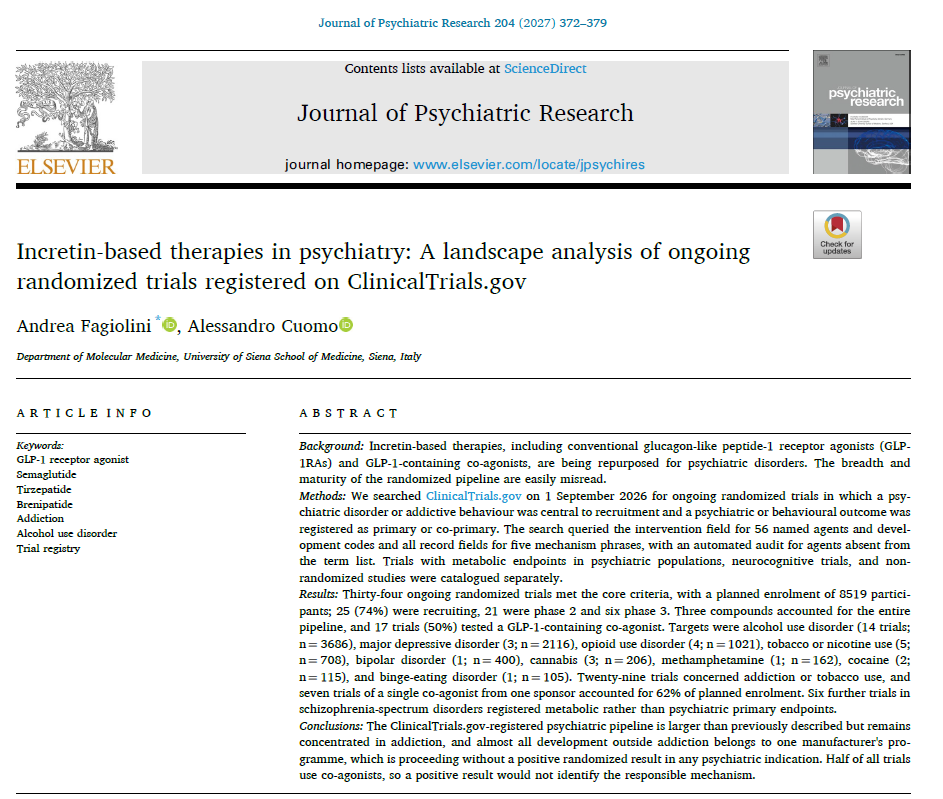
By integrating detailed clinical and psychopathological assessments with selected biological and other complementary measures, OPADE seeks to improve the prediction of treatment outcomes and support more individualized therapeutic decisions. Within this broader scientific framework, the newly published study explores an emerging therapeutic frontier: the potential role of incretin-based treatments, including GLP-1 receptor agonists and dual receptor agonists, in psychiatric disorders.
The analysis identified 34 ongoing randomized clinical trials involving more than 8,500 planned participants, particularly in substance use disorders and mood disorders. These findings highlight the growing interest in incretin-based therapies as potential additions to the psychiatric treatment landscape, while emphasizing the need to establish their clinical efficacy, tolerability, and potential role alongside existing pharmacological treatments. This is particularly relevant to depression, where identifying effective and well-tolerated therapeutic strategies, including appropriate augmentation and combination approaches, remains a major clinical challenge. The development of new treatment options must go hand in hand with a better understanding of which patients are most likely to benefit, which clinical characteristics predict response, and how treatments can be optimized to improve both symptomatic remission and real-world functioning.
This publication was conceived as one of the steps towards establishing the scientific background for future OPADE analyses focusing on treatment resistance and the therapeutic options available to patients identified as having treatment-resistant depression within the OPADE dataset.** It also aims to broaden the discussion of strategies to prevent and manage adverse effects of psychotropic medications, as well as medical conditions associated with psychiatric illness, pharmacological treatment, and patients’ lifestyles, such as overweight, obesity, and metabolic disturbances. In this context, incretin-based therapies represent a particularly interesting area of investigation, given their established metabolic benefits and their emerging potential applications in psychiatry. By exploring these therapeutic possibilities, the publication helps lay the groundwork for future OPADE research aimed at integrating clinical phenotypes, treatment response, tolerability, and physical health into a more comprehensive and personalized approach to the management of depression.
The publication also reflects OPADE’s commitment to advancing scientific knowledge and promoting open-access research while its clinical investigations continue
Read the full article here:
https://www.sciencedirect.com/science/article/pii/S0022395626005212